The Ministry of Civil Aviation (MoCA) has recommended travelers use Digi Yatra for hassle-free travel while the G20 Summit is currently taking place in the city. Passengers can promptly enter the airport and breeze through pre-security inspections with the help of this mobile application.
“Effortlessly breeze through Delhi Airport with facial recognition as your exclusive boarding pass, and contribute to congestion reduction during the G20 Summit,” the MoCA wrote in a tweet.
A Digi Yatra is what?
In order to provide efficient passenger processing at airports using facial recognition technology (FRT), the “Digi Yatra” app has been released. The travelers can take their time passing through each touchpoint. By using facial characteristics to verify their identity and travel information, passengers can pass through numerous checkpoints at airports using paperless and contactless processing, which can shorten the procedure from entry checks to security checks by up to 25 minutes.
The airport in Delhi’s “Digi Yatra” facilities:
All boarding gates of Terminal 1, Terminal 2, and Terminal 3 have been DigiYatra-enabled. More than 2,500 passengers use the facility every day at the airport.
when was ‘Digi Yatra’ first introduced?
On December 1st, 2022, Jyotiraditya Scindia announced the beginning of the “Digi Yatra.” This new system is being implemented by the government gradually. The app was initially launched in three airports: Bengaluru, Varanasi, and New Delhi. This was subsequently placed in airports in Vijayawada, Pune, Hyderabad, Kolkata, Mumbai, etc.
According to the IBEF analysis, India’s real estate market is expected to experience phenomenal development, reaching a value of US$ 1 trillion by 2030 and contributing 13% to the GDP by 2025. The recovery in 2022, highlighted by a 68% increase in home sales among the top eight cities, shows a tenacious upswing. After COVID, the sector shows promise as a large employer, providing a range of opportunities and promoting economic recovery. The crucial significance of repo rates emerges amidst these dynamics.
The repo rate is the interest rate at which the central bank lends money to commercial banks when they are short on cash (for example, the Reserve Bank of India in India). In India, real estate developers and start-ups are significantly impacted by this rate. It costs more for these companies to borrow money as the rate rises. Since they frequently rely on loans, this strains their finances, reduces profitability, and sluggishly accelerates their growth. Though they are all about innovation, higher taxes may discourage them from putting money into cutting-edge technology. Even investors may be hesitant, which might influence funding.
In other words, rising repo rates pose a financial, innovation, and investor interest issue. Over 95% of prospective homebuyers take future interest rate hikes into account when deciding whether to make a purchase, according to a CII-Anarock survey, underscoring the close relationship between rates and the housing market.
Foreign Direct Investment (FDI) in India is directly impacted by the repo rate. A higher repo rate raises the cost of borrowing for companies, especially foreign investors, which could deter FDI. On the other hand, a lower repo rate lowers borrowing costs, possibly luring in more foreign investment. The quantity of FDI inflows is significantly influenced by rate variations, which also have an impact on how appealing India’s business environment is to foreign investors overall.
The interest-sensitive real estate sector is alarmed by the RBI’s decision to keep the benchmark interest rate at 6.5 percent. Despite lending rates remaining steady, a series of increases of 250 basis points since May 2022 have decreased demand in important cities. A balanced strategy is required in light of this circumstance; the Reserve Bank of India (RBI) should take a considered approach to lowering interest rates. This action might revitalize the real estate market, which would therefore promote economic growth.
The COVID-19 effects and increased raw material costs have also changed the real estate market, which has been made more difficult by the rise in cement prices. Early in 2022, the price of cement per 50 kg bag increased on average by Rs 395, with annual increases of 12–15%. In June 2022, prices increased by Rs 25–30 per bag, which affected construction costs.
The Confederation of Real Estate Developers’ Associations of India (CREDAI) has issued a warning that any rate increases may increase the cost of borrowing for developers, increasing costs for projects and home prices. This may make business margins tighter given the rising cost of raw materials and rising house prices. Rising interest rates discourage homebuyers and have an impact on developer capital. Lowering repo rates is essential to boosting buyer confidence, driving up property sales, and boosting liquidity.
The housing price index (HPI) has climbed by about 10% during the last three years. Rising interest rates can present difficulties. Potential homebuyers find it more challenging to obtain loans as interest rates rise. Additionally, this raises property prices, preventing some people from buying. This alters market dynamics and slows sales as well.
On the other side, lower interest rates encourage the demand for real estate. They increase buyer interest and property values by making it more cheap to borrow money for real estate. Although this promotes purchasing, it may also result in decreased property supply, increased competition, and inflation. Therefore, a thorough strategy for India’s real estate growth includes not just lower interest rates but also supplementary tactics like tax breaks, regulatory changes, and infrastructure improvements.
India’s real estate industry can unlock its potential and make a big contribution to the nation’s economic landscape by negotiating the complex link between interest rates, market circumstances, and economic growth.
While aggressive strategies and legal issues have made DRAs less effective, a possible substitute known as Litigation Financing or Third-Party Funding (TPF) has developed.
Debt collection presents a significant difficulty for banks and other financial organizations in the complex world of financial services. Litigation financing and debt recovery agents (DRAs) are the two main methods that have surfaced. While aggressive strategies and legal issues have made DRAs less effective, a possible substitute known as Litigation Financing or Third-Party Funding (TPF) has developed. TPF entails the funding of litigation expenses by third parties in exchange for a portion of the winnings in successful cases. TPF is given a boost by the DRA’s lack of regulations because it enables claimants to seek justice and investigate their own claims even when they have minimal financial resources.
Debt recovery agents: What are they?
Debt recovery agents are considered to be typical ways for financial institutions to recover their bad loans when we consider the situation in India. These representatives are in charge of dealing with defaulters personally and making an effort to recoup unpaid payments. Under the SARFAESI Act, the Reserve Bank of India (RBI) is in charge of regulating DRAs. When a loan becomes a non-performing asset (NPA), the borrower receives a notice requiring repayment within 60 days. If the borrower fails to pay the credit within the required period, the creditor may take action without involving the courts, including selling the loan to an asset reconstruction company at a discounted price.
Problems with Debt Recovery Methods
Finance Minister Nirmala Sitharaman addressed the mounting allegations during the most recent Lok Sabha session regarding the DRAs’ use of illegitimate means to collect loans. Numerous complaints and legal issues have been caused by the Debt Recovery Agents’ intrusive and aggressive tactics. Although the RBI has set rules to limit their excesses, this is still out of control.
A Fight for Results That Are Satisfactory
The recovery rate in DRAs has been dismal since this aggression in the traditional technique, with a success rate of only 2 out of 10 instances. This makes it very difficult for the creditor to collect the debts. And the Indian system is still having trouble dealing with a lot of NPAs. With the intention of swift adjudication and debt recovery, the government established Debt Recovery Tribunals under the RDB Act, 1993, to address this issue. The cost of the litigation, however, would be prohibitive for the creditors under this tribunal’s arrangement.
There are many problems with the conventional strategy of using DRAs for debt recovery in India, including aggressive tactics, dismal success rates, and procedural difficulties. Even though the government created Debt Recovery Tribunals to speed up the procedure, the fees continue to be an issue. Alternative approaches to debt recovery are gaining pace and could provide a more efficient and just method of collecting debt, such as litigation financing, which offers financial help to claimants during court challenges.
Legal Dispute Financing: A New Evolution
Also referred to as “Third-party funding,” this idea is still relatively new in India. A third-party funder provides financial support for the cost of litigation in this novel strategy. If the case is successful, the funder gets compensated with a portion of the winnings. Some TPF providers are known for their “NO WIN NO FEE” business strategy, which states that they only get paid if the case is won.
The slow adoption of litigation financing in India
When we consider industrialized nations like the USA and the UK that already adopted this model as early as the 2000s, making it an established practice in their legal systems, India is not an exception to the growing popularity of this technique. TPF would level the playing field for claimants who might otherwise lack the financial wherewithal to pursue their legal claims as it acquires recognition and acceptance in India.
Let us Consider a tiny business that invested heavily in costly machinery from a larger organization. When there is a disagreement over the purchase agreement, the larger company refuses to give the smaller company its money back. Instead, they make a meager settlement offer. The smaller company feels obligated to accept the subpar settlement offer due to its limited credit resources.
However, the larger organization would be aware that the disagreement could go to court if the smaller business had access to litigation finance plans. With this information, the smaller company would receive fairer and more equitable settlement conditions.
This third-party funding has the potential to increase access to justice and give claimants the freedom to pursue proper recompense without having to pay upfront fees. It is anticipated that TPF will gain traction in the Indian judicial system as awareness of it increases and the benefits of using it become more clear, giving claimants looking for a just resolution to their legal problems a useful resource.
Financial regulation in the future?
The Litigation Financing has a great deal of potential to revolutionize debt collection. The absence of clear regulation, however, presents difficulties and necessitates a strong structure to assure responsible execution. It can revolutionize debt recovery in India and offer an ethical and effective alternative to DRAs with the right regulation. Adopting litigation financing levels the playing field for claimants with low means and gives them the ability to pursue reasonable recompense by aligning with values of justice, fairness, and efficiency. India needs to embrace the future of debt forgiveness.
Loans against securities are a cost-effective option for borrowers with significant holdings, while personal loans are an accessible option for those without.
Depending on your financial status and funding requirements, you may choose to choose between a personal loan and a loan against securities. Every loan kind has advantages and downsides of its own, so you should choose one after carefully weighing your needs.
In order to obtain a loan from a financial institution or lender, people might use their current financial assets, such as stocks, mutual funds, or other securities, as collateral. This financial instrument is known as a loan against securities. Borrowers can obtain funds with this kind of loan without having to liquidate their investments. A personal loan, on the other hand, is an unsecured loan and is therefore available to a wider variety of applicants. When deciding between the two, keep the following things in mind:
A loan secured by securities
Collateral for investments: You must offer your securities, such as stocks or mutual funds, as security. The lender may sell your securities to recoup the loan balance if you default on it.
Rates of interest: Because these loans are secured by collateral, they often have lower interest rates than personal loans do. Depending on the lender, interest rates can range between 9% and 14%. A loan against securities might have cheaper rates if you have valuable securities and feel confident pledging them without jeopardizing your financial security.
Credit amount: The value of the securities you pledge as collateral will typically determine the loan amount. It might be between 50% and 70% of the entire value of the securities. According to the borrower and the lender, it might be higher in some circumstances.
Tenure: Compared to personal loans, lending terms for loans against stocks are frequently shorter. The offered repayment period ranges from one year to three years. However, this can change based on your lender and the loan conditions.
Processing period: Since the lender already has the collateral in their possession, processing times for these loans are quicker. A loan against securities might be more appropriate if you require immediate access to money because of its quicker processing.
Investment risk: If you are unable to repay the loan, you run the risk of losing your investments. You can be required to pledge more securities or make partial loan repayments if the value of your securities dramatically declines.
According to Bankbazaar.com CEO Adhil Shetty, “Depending on your repayment methods and funding needs, you must carefully choose your solution. The lenders have the right to sell your holdings in order to recoup their losses if you are unable to repay the loan against securities throughout the loan term.
Personal loan
Collateral-free: There is no need for collateral for personal loans. Since they are unsecured loans, anyone can apply for them even if they don’t have any valuable assets to pledge. You can be eligible for a personal loan with favorable terms if you have a strong credit rating and a consistent source of income.
Interest rates: Because personal loans have a larger level of risk for the lender than loans secured by securities, they typically have higher interest rates. The interest rate could range between 11% and 15%. The bank and your credit score will determine whether it is lower or greater.
According to Shetty, “Personal loans can be a useful financial tool when used responsibly, but borrowers should carefully consider their ability to repay and compare offers from different lenders to secure the best terms and interest rates for their needs.”
Loan amount: Your creditworthiness, income, and other financial considerations will all have an impact on how much you can borrow from a personal lender. It might be less than what you could receive from a loan secured by securities.
Tenure: Personal loans can include adjustable repayment terms, letting you select the length of time that best suits your financial circumstances. It might be anywhere from 12 to 60 months.
Processing time: Because the lender must evaluate your creditworthiness and financial history, the approval process for personal loans may take longer. However, you can also receive pre-approved offers for personal loans if your credit history is spotless and you make your debt payments on time.
Risk: Personal loans don’t put your assets at danger, but missing payments can hurt your credit report and limit your ability to borrow money in the future. Before applying for a personal loan, it is advised to weigh all the advantages and disadvantages. Additionally, paying more in interest may put you at risk of default. Therefore, even before asking for the loans, one must have a repayment strategy prepared.
“The decision between a loan against securities and a personal loan depends on individual financial circumstances,” explains Raoul Kapoor, co-CEO of Andromeda Sales and Distribution. Loans secured by securities, such as stocks or bonds, offer lower interest rates and bigger loan amounts based on the value of the collateral. Personal loans, in contrast, have higher interest rates that are, say, 1.5% to 2% greater than those that apply to loans secured by property, are unsecured and are accessible without collateral.
Loan against securities is a cost-effective option for borrowers with significant holdings, whilst personal loans are an accessible option for those without. In the end, the choice should be in line with one’s financial objectives, risk tolerance, and availability of collateral.
GETTING FINANCES
Your repayment plans will determine whether you choose a personal loan or a loan against securities.
You can be required to pledge more securities or pay back a portion of the loan if the value of your securities declines.
Personal loans require a longer approval process because the lender must determine your creditworthiness.
The West Bengal governor issued a midnight threat of “bigger action” due to his ongoing dispute with the education minister. Governor CV Ananda Bose forewarned of a much larger action at midnight on Saturday, a day after West Bengal Education Minister Bratya Basu accused him of attempting to “destroy” the state’s higher education system and presiding over a “puppet regime” in institutions.
A Raj Bhavan official reported that Bose had “signed two confidential sealed letters,” one for the state secretariat, Nabanna, and the other for the Centre, as the clock was getting close to midnight.
The official stated that “it would be disclosed later” in regard to the letter’s contents.
The person continued, “The governor signed two confidential letters tonight, one intended for Nabanna and the other for Delhi.”
The person told PTI that the letters’ contents would be revealed later and hinted that they would deal with the current spat between the governor and the state government.
A few hours after attending a lengthy meeting with the chief secretary, HK Dwivedi, at Raj Bhavan, Bose signed the letters.
But neither the state administration nor the Raj Bhavan made any mention of the meeting’s subject.
In light of the harsh criticism and attacks leveled by the state education minister earlier in the day, Bose issued a warning of far greater action at midnight.
“Await the moment that midnight strikes today. You will witness what is going on,” Bose had told reporters in the afternoon, outside of a program taking place here.
Following Bose’s remark, Basu made fun of the governor by referring to him as the “new vampire in town” and admonished the populace to “beware of him” without specifically naming the man.
“Watch until midnight to catch the action.” BEWARE! ALWAYS BE CAREFUL! brand-new vampire in town! Please keep an eye on yourselves, citizens. Eagerly anticipating the “Rakkhas Prahar” (monster prahar), as described in Indian mythology,” wrote Basu on ‘X’.
The West Bengal administration and the Raj Bhavan have been engaged in a verbal spat over the appointment of interim vice-chancellors in institutions. On Friday, Basu accused the governor of attempting to “destroy” the state’s higher education system.
The governor, who serves as the chancellor of state-run universities, was also accused by the minister of running a “puppet regime” in the universities and of intimidating registrars into not meeting with the higher education department.
“The honorable governor wants to choose individuals based on his fancies in order to appease someone’s ego. He is always working to undermine the higher education system, according to Basu.
In a statement, the West Bengal Educationists’ Forum referred to Bose’s remarks on the midnight action as “threats”.
“It is unfortunate to witness the chancellor blaring out threats of staging a midnight drama of revenge against the educationists and the officials and functionaries of the state higher education department,” the statement read.
The chief minister harshly criticized the governor’s appointment of interim vice chancellors for eight universities, including the prestigious Presidency University, MAKAUT, and the University of Burdwan, in his capacity as chancellor of state-run universities. The move was seen as an attempt to meddle with the management of state-administered universities.
According to sources, appointment letters for the interim vice-chancellors of eight more universities “will be issued soon” after they have been finalized.
On Sunday, the cost of a litre of gasoline and diesel in Delhi was 96.72 and 89.62, respectively. In India, the cost of gasoline and diesel has been stable for more than a year; the most recent change took place in May 2022. Due to elements like state and local taxes, value-added tax (VAT), freight costs, and other regional considerations, these prices can differ from one state to the next.
Major cities like New Delhi, Kolkata, Mumbai, Lucknow, Bengaluru, Noida, and Chennai have not seen any changes in the costs of gasoline and diesel, according to the daily 6 a.m. price data issued by oil marketing organizations, according to the Goodreturns website.
City
Petrol (Rs/litre)
Diesel (Rs/litre)
Bengaluru
101.94
87.89
Lucknow
96.7
89.66
New Delhi
96.72
89.62
Kolkata
106.03
92.76
Mumbai
106.31
94.27
Noida
96.65
89.82
Chennai
102.63
94.24
The central government of India controls fuel pricing, which is influenced by things like excise duty, base prices, and price caps. Value Added Tax (VAT) collection is handled by the states, whereas excise tax collection is handled by the federal government. Fuel costs can fluctuate as a result of the different VAT rates that each state applies.
Up until September 30, qualified people may apply for these positions at hindustancopper.com. For 26 openings for grade 1 Mining Mate and Assistant Foreman (Mining) positions, Hindustan Copper Limited is accepting online applications. Up until September 30, qualified people may apply for these positions at hindustancopper.com. By October 14, they must also send the form in hard copy.
Vacancy information:
10 openings for assistant foreman (mining).
Education and experience requirements: either a Matriculation with six years of experience in big underground metalliferous mines, including at least one year in a supervisory role, or a Mining Engineering Diploma with three years of experience in such mines.
Adequate Mines Foreman Valid First Aid certification and a certificate of competency for metalliferous mines (unrestricted).
16 openings for mining mates in grade 1.
Education and experience requirements: Matric with five years of experience in major underground metalliferous mines or a diploma in mining engineering with three years of experience and
Valid First Aid certification and Mining Mate Certificate of Competency for Metalliferous Mines (unrestricted).
By October, the Reserve Bank of India will probably start a trial program for Central Bank Digital Currency (CBDC) for interbank borrowing. Ajay Kumar Choudhary, executive director of the Reserve Bank of India, stated on Sunday that the pilot program for Central Bank Digital Currency (CBDC) for interbank borrowing or call money market operations is set to begin in October.
On November 1, 2022, the Digital Rupee-Wholesale (e-W) trial of the wholesale CBDC was introduced, with the use case restricted to the settlement of secondary market transactions in government securities.
“The RBI will introduce the wholesale CBDC in the call market either this month or next month,” Choudhary said here, on the eve of the G20 Leaders’ Summit.
Nirmala Sitharaman, the finance minister, announced the implementation of CBDC in the Union Budget 2022–2023; the necessary changes to the relevant part of the RBI Act, 1934, were made with the adoption of the Finance Bill 2022.
For its pilot project for wholesale CBDC, the RBI chose nine banks: State Bank of India, Bank of Baroda, Union Bank of India, HDFC Bank, ICICI Bank, Kotak Mahindra Bank, YES Bank, IDFC First Bank, and HSBC.
Additionally, on December 1, 2022, the central bank will roll out a pilot for the CBDC (e-R) retail version. The e-R is a digital token that serves as money and is represented by legal tender.
It is being distributed in the same denominations as coins and paper money. Through financial intermediaries like banks, it is being spread. Through a digital wallet provided by the collaborating banks, users can conduct transactions with e-R.
At the G20 Summit’s exhibition pavilion, the RBI is displaying several digital financial sector activities.
These include the CBDC, UPI One World, RuPay On-The-Go, and Public Tech Platform (PTP) for Frictionless Credit.
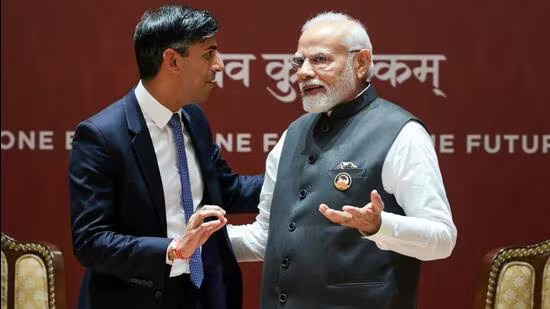
At the G20 Summit, UK PM Rishi Sunak pledged a record $2 billion to the Green Climate Fund while highlighting the need for immediate climate action. According to the British High Commission in India, on Sunday, ahead of the second day of the G20 Summit in New Delhi, UK Prime Minister Rishi Sunak announced a commitment of a record $2 billion to the Green Climate Fund (GCF), marking the largest single funding contribution by the UK to combat climate change on a global scale. The Green Climate Fund, which was created by 194 nations as part of the Copenhagen Accord at COP15, is essential for funding projects and programs that address climate change.
“Today’s pledge represents a 12.7% increase over the UK’s previous contribution to the GCF for the period of 2020-2023, which was itself a doubling of our initial funding to establish the fund in 2014,” a UK government release stated.
During his speech at the G20 Summit, Sunak stressed the necessity of taking urgent climate action and urged world leaders to join forces in their determination to cut carbon emissions and support countries dealing with the negative effects of climate change.
According to Sunak, who was quoted by the Prime Minister’s Office, “The UK is stepping up and delivering on our climate commitments, both by decarbonizing our own economy and helping the world’s most vulnerable to deal with the impact of climate change.”
“This is the caliber of leadership that the G20 nations should be exhibiting, in my opinion. And this government will continue to set an excellent example in fostering prosperity and security throughout the world, including in the UK, he said.
Key global issues, such as climate change, were discussed during the G20 Summit, which brought together the heads of the world’s greatest economies.
Following the prosperous G20 Summit, the focus will turn to the next COP28 Summit, when countries are anticipated to make crucial choices and promises to curb global warming and lessen its effects.
At the G20 Summit, Prime Minister Modi unveiled the Global Biofuel Alliance, which aims to advance sustainable biofuels and lessen reliance on fossil fuels. The Global Biofuel Alliance was inaugurated on Saturday during the G20 Summit in New Delhi by Prime Minister Narendra Modi, US President Joe Biden, Brazilian President Luiz Inacio, Argentina’s Alberto Fernández, and Italian Prime Minister Giorgia Meloni, among others.
In a social media post thanking the members, Modi stated, “The launch of the Global Biofuels Alliance marks a significant milestone in our pursuit of sustainability and clean energy.”
What is the Global Biofuels Alliance trying to achieve?
India is the G20 Chair, and it is leading a project called the Global Biofuel Alliance (GBA). According to a statement from the Ministry of External Affairs, the Alliance seeks to hasten the global adoption of biofuels by encouraging technological advancements, expanding the use of sustainable biofuels, and establishing rigorous standards and certification procedures with the active participation of many stakeholders.
The alliance would also act as a hub for experts and a central knowledge store. The ministry noted that GBA aims to serve as a catalyst for international cooperation in promoting and broadly implementing biofuels.
What are India’s advantages in the alliance?
As the founder and director of Biofuels Junction, Ashvin Patil told HT, “Collaboration within the Global Biofuel Alliance and with other countries will play a pivotal role in India’s transition to clean energy, facilitating technology exchange, hastening the adoption of eco-friendly biofuels, reducing dependence on fossil fuels, and aligning with climate and energy goals.
According to the Indian Biogas Association (IBA), the biofuel alliance might provide the G20 with the chance of USD 500 billion over the next three years.
With a Compound Annual Growth Rate (CAGR) of almost 22% over the previous six years, India significantly boosted the proportion of renewable energy in the country’s overall energy mix. The solar and wind energy industries have also seen tremendous growth in the nation; throughout this time, they have experienced CAGRs of 38% and 30%, respectively.
The Ministry of New and Renewable Energy reports that India currently produces 1151 MT per day of compressed biogas and biogas. Even conservative projections indicate that this may rise to 1750 MT per day by 2025 with a concerted effort in the sector.
IBA said the alliance will assist G20 nations in reducing their reliance on fossil fuels. Within the next three years, it is anticipated that the overall import bill for non-fossil fuels could be substantially reduced, helping these nations achieve their Sustainable Development Goals.